Stories I Wanted to Share (#125)
The postmark crisis and elections; Arkansas endangers women’s lives; redistricting horrors could lead to dummymanders; proportional representation and multi-member districts; Senate Democrats vote to confirm corrupt judicial nominees; Stephen Colbert; and what Rothko represents your current weather.


In this edition: eight stories with 15 links I’ve recently wanted to share about where things stand in our long, twilight struggle to defeat authoritarianism.
Here we go. We will win. I’m glad you’re here.
“It might be helpful for you to know that you are not alone. And that in the long, twilight struggle which lies ahead of us, there is the possibility of hope.” “The Long Twilight Struggle.” Babylon 5, created and written by J. Michael Straczynski, Season 2, Episode 20, 1995.
#1
- Trump’s Secret Move to Subvert Elections (Julie Roginsky, Salty Politics, Link to Article)
- When a postmark no longer tracks mailing (Elena Patel, The Brookings Institution, Link to Article)
The Brookings Institution's Elena Patel writes:
On December 24, 2025, a quiet change took effect in the Postal Service’s Domestic Mail Manual. The new section (DMM 608.11) now clarifies that a postmark will no longer indicate the date a piece of mail was deposited with U.S. Postal Service (USPS). The Postal Service notes this misalignment “has and will become more common” as it continues consolidating its processing network and standardizing transportation schedules under the Delivering for America (DFA) plan.
Although the rule is technical, its implications reach well beyond postal operations. For more than 70 years, legal and administrative systems have treated a postmark as reliable evidence of when an individual met a deadline: when a ballot was mailed, when a tax return was filed, when a court document was submitted, or when an application was received. This reliance made sense in a network where most mail entered processing close to where it was deposited, keeping the postmark closely aligned with the date of mailing.
But what happens when the legal and administrative systems that depend on postmarks face a network where postmarks no longer reflect when something was sent?
Julie Roginsky writes:
Now, to be clear, the Postal Service’s official framing is administrative: modern processing networks, consolidated distribution, operational efficiency, all the eye-glazing nouns that let institutions avoid discussing harm. USPS also formally announced the DMM update in the Federal Register, which is where inconvenient policy details go to die of boredom.
But politics is the art of exploiting boredom.
And Trump has always understood that you don’t have to win the constitutional argument if you can win the logistical one. If you can’t outlaw mail voting outright because states regulate elections, you make mail voting riskier, more confusing, and easier to challenge — especially in close races where one side is already primed to see conspiracy in every envelope.
This is where the postmark change lands like a match in dry grass. Even if most ballots are not decided by postmark rules alone, the perception that postmarks are unreliable creates exactly the kind of chaos that litigation-feeding ecosystems love: Was this mailed on time? Is this valid? Did the voter do enough? Did the system do enough? Who bears the burden when the date stamp doesn’t match reality?
And chaos, as Trump taught us, is not a bug. It’s the brand.
WHY I WANTED TO SHARE THESE STORIES
I think Julie Roginsky is correct in her assessment. Since the Trump regime can’t eliminate mail-in voting, they chose to create confusion and chaos in the main part of the process they do control: the United States Postal Service.
Yes, the USPS faces budget problems as letter volume falls while its universal service mandate remains in place.
But the postmark is such a keystone of so many of our systems—from voting to taxes to legal filings—that protecting its relevance should be one of our government’s priorities.
So we are right to wonder why it isn’t. The Trump regime is not subtle.
A service promised in the Constitution shouldn’t be focused on making a profit.
If you are planning to vote by mail it is vital that you do so earlier than you have in the past if you can’t get a postmark at the post office counter. You may also want to use election drop boxes if they are available in your community.
I plan to use an official drop box when I vote in the California primary this week. I don’t want to take any chances, even in a blue part of a blue state.
We are going to have to do a lot of work to make sure voters across the country understand what they need to do to ensure their vote is counted in the critical elections coming up.
#2
- She Faced a Life-Threatening Miscarriage. Under Arkansas’ Abortion Ban, Even Calls to the Governor’s Office Didn’t Help. (Kavitha Surana, ProPublica, Link to Article)
“Your body is about to miscarry,” the doctor said.
Three doctors gathered and told the couple that the longer Waldorf’s cervix remained open and her uterus exposed to bacteria, the higher her risk of developing a life-threatening infection. The standard of care, they explained, would be to quickly empty her womb.
But they couldn’t do that, one doctor said apologetically, sighing deeply. The baby still had a detectable heartbeat, and stopping it would run afoul of a state abortion ban that snapped into place after the Supreme Court overturned Roe v. Wade in 2022; violations carried penalties of up to $100,000 in fines and 10 years in prison. They needed to wait until Waldorf went into labor on her own or showed signs of a dangerous infection, or until the fetal heartbeat ended.
“Our hands are tied behind our backs,” Dr. Erin Large later told her, according to a journal Waldorf began keeping on her phone and shared with ProPublica. “Tell your friends to vote differently.”
Raised Baptist in a Republican family, Waldorf struggled to understand what the doctors were saying as waves of grief hit her. How could an abortion ban aimed at women who wanted to end their pregnancies keep doctors from helping a woman who didn’t?
WHY I WANTED TO SHARE THIS STORY
I am thankful that Emily Waldorf is sharing the story of her miscarriage to explain how punitive abortion bans like the one in Arkansas actually work.
Waldorf started journaling her experience after finding out she could not receive the standard of care required to ensure her health and safety.
She tells a story about how her health situation was ignored even as it deteriorated. How friends contacted the office of Arkansas Governor Sarah Huckabee Sanders and received no help.
She had to take an expensive ambulance across state lines to Kansas in order to get the care her situation required.
Pregnancy is a complicated process. It is impossible to legislate for every eventuality. This is why the decision should be left to the pregnant person and her doctor.
Women should not have to suffer and end up with large medical bills to receive obvious medical treatment. Stories like Waldorf’s are an important part of exposing what these hateful forced-birth laws actually do.
This situation is one of the reasons why expanding the Supreme Court and eliminating the Senate filibuster are necessary the next time Democrats have a federal government trifecta. It is the only way to make abortion access legal nationwide to protect the many other women facing heartbreaking situations like Waldorf’s.
#3
- Republicans Don’t Need to Win Elections Anymore. They Just Need Their Judges. (Ari Berman, Mother Jones, Link to Article)
- The VA Supreme Court’s embarrassing legal error (Ian Millhiser, Vox’s SCOTUS Explained, Link to Article)
- Visual: The partisan lean of Tennessee’s proposed new U.S. House map (Adam Friedman, Tennessee Lookout, Link to Article)
Ian Millhiser writes:
By a 4-3 vote, the Virginia Supreme Court just struck down that state’s recently enacted congressional maps, which were intended to give Democrats four additional seats in the state’s congressional election after the upcoming midterms. The state enacted these new maps to cancel out Republican gerrymanders in Texas and other red states.
Both the majority opinion and the dissent in Scott v. McDougle hyperfixate on the meaning of the word “election” in the Virginia state constitution, and neither opinion is particularly persuasive. Both sides are able to cite a raft of dictionaries, historical sources, past precedents, and other sources that support their preferred definition of this word.
<snip>
The majority of the state Supreme Court, however, claims that the more recent amendment is invalid because, when the state legislature first proposed this amendment in October 2025, it did so after early voting had already begun in the state. This is a problem, they claim, because it means that “1.3 million or so Virginians” had already cast their ballots before the amendment was proposed, and thus they were denied their opportunity to express support or disapproval of the proposed amendment when they cast their vote for state lawmakers.
In essence, the majority argues that Virginia voters who opposed the amendment were disenfranchised because they were denied an opportunity to vote for lawmakers who oppose it in the 2025 state legislative elections.
But there’s a pretty glaring problem with this disenfranchisement argument: The amendment was submitted to the voters in a referendum. Virginia voters were, in fact, given an opportunity to cast an up or down vote on the redistricting amendment. And a majority of them voted to approve it.
Ari Berman adds:
The decision effectively tosses out three million votes cast in the referendum on a legal technicality. It’s worth noting that voters in red states have not been able to weigh in on any of the mid-decade gerrymanders passed by their legislatures. And while those states have different laws than Virginia, voters in Florida and Ohio did pass prohibitions on gerrymandering that their legislatures flagrantly ignored—but conservative-dominated state supreme courts in those states are unlikely to void the new maps.
It’s impossible to ignore the national context: It appears that Democrats are bound by one set of rules while Republicans play by another, and Republican-appointed judges have repeatedly put their collective thumb on the scale of elections to make sure their party prevails.
WHY I WANTED TO SHARE THESE STORIES
A group of judges throwing out the results of an election on a technicality they could have used to keep the election from happening is quite the middle finger to the sovereignty of the people as expressed through their votes.
What? That result was not what we expected. Well, then, we will just pretend that didn’t happen is a great way to get more voters to lose faith in our judiciary.
But it is part of a pattern. GOP legislatures and judges keep ignoring or nullifying election results (as we have seen in Ohio and Missouri as their legislators ignore votes to make abortion safe and legal in those states).
I hope voters in Virginia respond with anger to this judicial coup. High voter turnout, after all, can create wonderful dummymanders. Let’s make these Republican MAGA jerks sad with some unexpected voter-led retirements.
Speaking of dummymanders, Tennessee Lookout’s Adam Friedman crunched the numbers from the Dave’s Redistricting website to see what the new partisan leans were of the new districts created in that state.
Given the Democratic overperformance in elections since Trump took office, the results are intriguing. The new racial gerrymanders in the south use 2024 voter patterns as their base. But that may be a mistake given how Trump has alienated parts of the coalition that won him the election.
Plus, Republican voters tend not to turn out as much in general elections when Trump is not on the ballot. So look at the numbers from 2018 in the right column below.
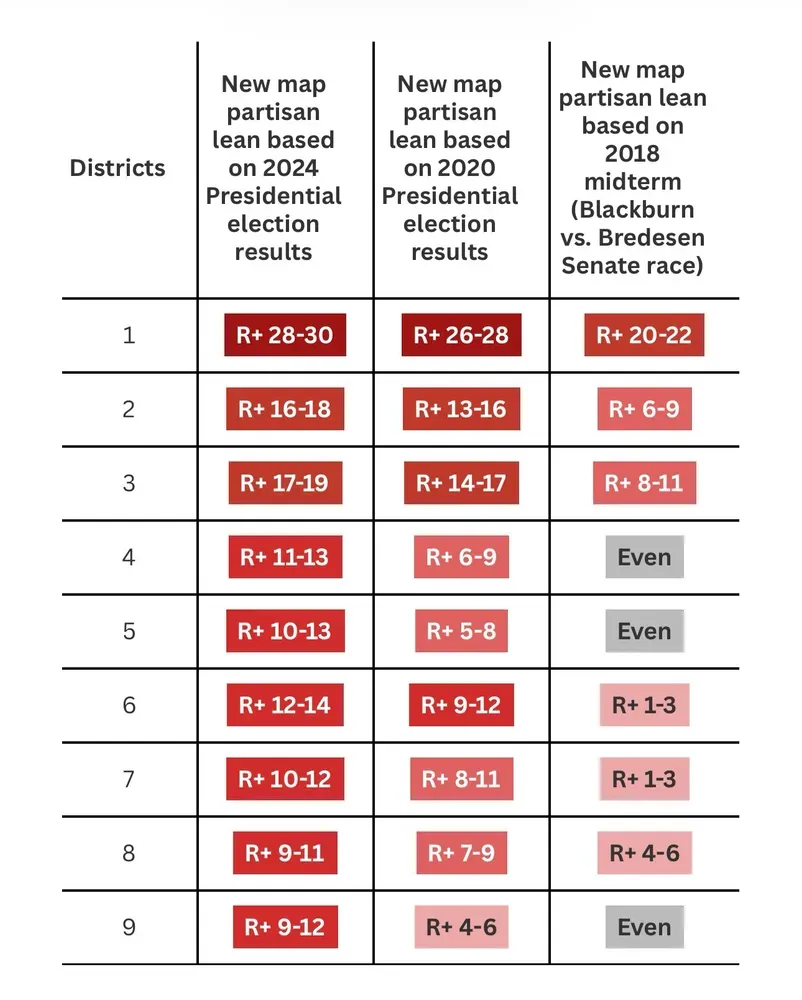
Great candidates and high turnout and easily turn this Tennessee Republicans’ racist redistricting atrocity into an epic dummymander. That would be such a sweet outcome. Let’s make this happen.
But, going forward, we need real reform to protect voting rights now that the Supreme Court and the MAGA Republican Party have rejected multicultural democracy.
And there is an electoral system that can address these issues. It is one used by most democracies throughout the world. Even better, it does not require a constitutional amendment to implement.
#4
- Protecting voting rights with proportional representation (Lakeisha Steele, G. Michael Parsons, Rachel Hutchinson, Fair Vote, Link to Article)
- Update on Proportional Representation (American Academy of Arts & Sciences, Link to Article)
- PR Can Reduce the Impact of Gerrymandering (Peter Miller and Michael Li, Democracy Journal, Link to Article)
- For a Better Democracy: Proportional Representation (Democracy Journal Symposium, Link to Index of Articles)
Fair Vote’s Lakeisha Steele, G. Michael Parsons, and Rachel Hutchinson write:
Under our current system, each district only elects one legislator. Single-member districts can safeguard representation for communities of color when mapmakers draw the lines in a way that ensures an equal opportunity to win seats – or, failing that, when courts step in to protect voters against discriminatory maps.
But when politicians and judges both turn their backs on the VRA’s promise of equal opportunity, the power of single-member districts to protect communities against discrimination becomes more limited.
Single-seat elections are “winner-take-all”: The biggest group of voters in the district gets 100% of the representation – and everyone else gets nothing. Without robust enforcement of the Voting Rights Act, winner-take-all elections silence voters in the minority, inflate the influence of voters in the majority, and place unchecked power in the hands of mapmakers.
Under proportional representation, each district would elect multiple legislators, and groups of voters would elect winners equal to their share of the vote: If a group casts 35% of votes, that group wins roughly 35% of the seats. This intuitive and powerful approach provides a structural protection for voting rights that does not rely on the good will of judges or legislators (or even redistricting commissions) to produce inclusive and representative maps.
With fewer district lines to draw, proportional systems reduce the power of mapmakers to determine who wins and loses – giving more power back to voters. And with more legislators from each district, proportional systems give more communities a seat at the table – no matter what the Supreme Court decides in Callais.
As the number of seats in each district goes up, so too do the opportunities for more groups to have a voice in government. For example, a 3-seat election only requires 25% of the vote to win. And in a 5-seat district, any group of voters larger than 16.7% could elect a candidate of their choice. This gives voters of color across an entire state, not just those in select districts, a chance to elect their preferred candidates – and a chance to hold more of their state’s elected leaders accountable.
And as a recent report from the American Academy of Arts & Sciences observes:
As the report explains, current law requires states to use single-member Congressional districts. The candidate with more votes than any competitor wins the entire district – they “take all” – leaving many voters with a representative they did not vote for. The report argues that moving to a proportional system with multi-member districts improves representation for many such voters. It also virtually eliminates gerrymandering, improves voter turnout, and reduces political polarization.
This change only requires amending current law – the Uniform Congressional District Act, enacted in 1967 by Congress – and does not require amending the U.S. Constitution.
WHY I WANTED TO SHARE THESE STORIES
I am concerned that voters and activists may sink into despair because our current fight against authoritarianism may appear hopeless as MAGA Republicans and the Federalist Society courts do everything possible to achieve their white supremacist dreams.
But there are solutions available. Many of them don’t require constitutional amendments. They just require majority votes if the Senate filibuster is eliminated.
So, besides increasing the size of the Supreme Court and stripping it of jurisdiction to consider the constitutionality of issues related to redistricting and voter rights, what can we do?
Proportional representation elections in multimember districts eliminate gerrymanders. They also can help create space for coalitions to elect more people of color.
Peter Miller and Michael Li explored in Democracy Journal how Texas (redistricted for Republicans) and Massachusetts (where it is mathematically impossible to draw a district likely to elect a Democrat) would fare with multimember districts under a proportional representation system.
As shown below, the results in both Texas and Massachusetts were striking. In Texas, Democrats gain seats and almost perfectly match their statewide vote share (18 of 38 seats is 47.4 percent of the seats) under both the map built from gerrymandered districts and the map built from non-gerrymandered districts. District configuration did not alter the results. The politically skewed map and the politically balanced map performed the same. Likewise, in Massachusetts, when districts are combined into a five-member district and another four-member district and seats are allocated using a proportional system, Republican votes can be better aggregated. The result is that the party wins three of the nine seats in the state, roughly in line with the Republican share of the statewide vote.

Voters in the minority political party would have representatives closer to the statewide vote share. This would make most voters have a vote that obviously matters to the outcome.
And, as the Fair Vote report explains, almost every multimember district in the nation would elect at least one member from the minority party. Multimember districts also make it possible for people of color from a large area to work together to elect someone from their community. The community created is natural—it requires no court ruling or fairly drawn map.
Multimember districts would nullify the evil work Chief Justice John Roberts and the MAGA 6 have done. That’s a good enough reason to want Democrats to enact them as soon as they have a trifecta. That requires us to start talking about such solutions now to build support for the reform.
#5
- Senate Democrats Are Not Taking Their Jobs Seriously (Jay Willis, Balls and Strikes, Link to Article)
- Eight Democrats vote to confirm a lifetime judge who wouldn’t say Biden won in 2020 (Patrick McNeil, Nomination Notes, Link to Article)
Jay Willis writes:
As the ranking Democrat on the Senate Judiciary Committee, among Illinois Senator Dick Durbin’s many responsibilities is sending a clear, forceful message about the party’s opposition to President Donald Trump’s judicial nominees. To date, Durbin has focused heavily on the fact that in their confirmation hearings, aspiring judges have uniformly refused to say that Trump lost the 2020 election, or to condemn the January 6 insurrection, or to do anything else that might prompt their notoriously fickle overlord to pull their nominations at the last minute.
“Have you seen the contortions that these nominees have gone through when they’re asked the basic question, ‘Who won the election in 2020?’” Durbin asked at a hearing in April. “They can’t answer it because it’s an article of faith: If you’re loyal to Trump, you never accept the premise that he lost an election.” In March, Durbin warned that Trump was looking to “stack the courts” with “MAGA loyalists who will rule in his favor.” Earlier this week, while questioning one of Trump’s former defense attorneys who is now (surprise!) up for a seat on the Second Circuit, Durbin described Trump nominees as united by their willingness to “ignore the rule of law so long as they follow his agenda.”
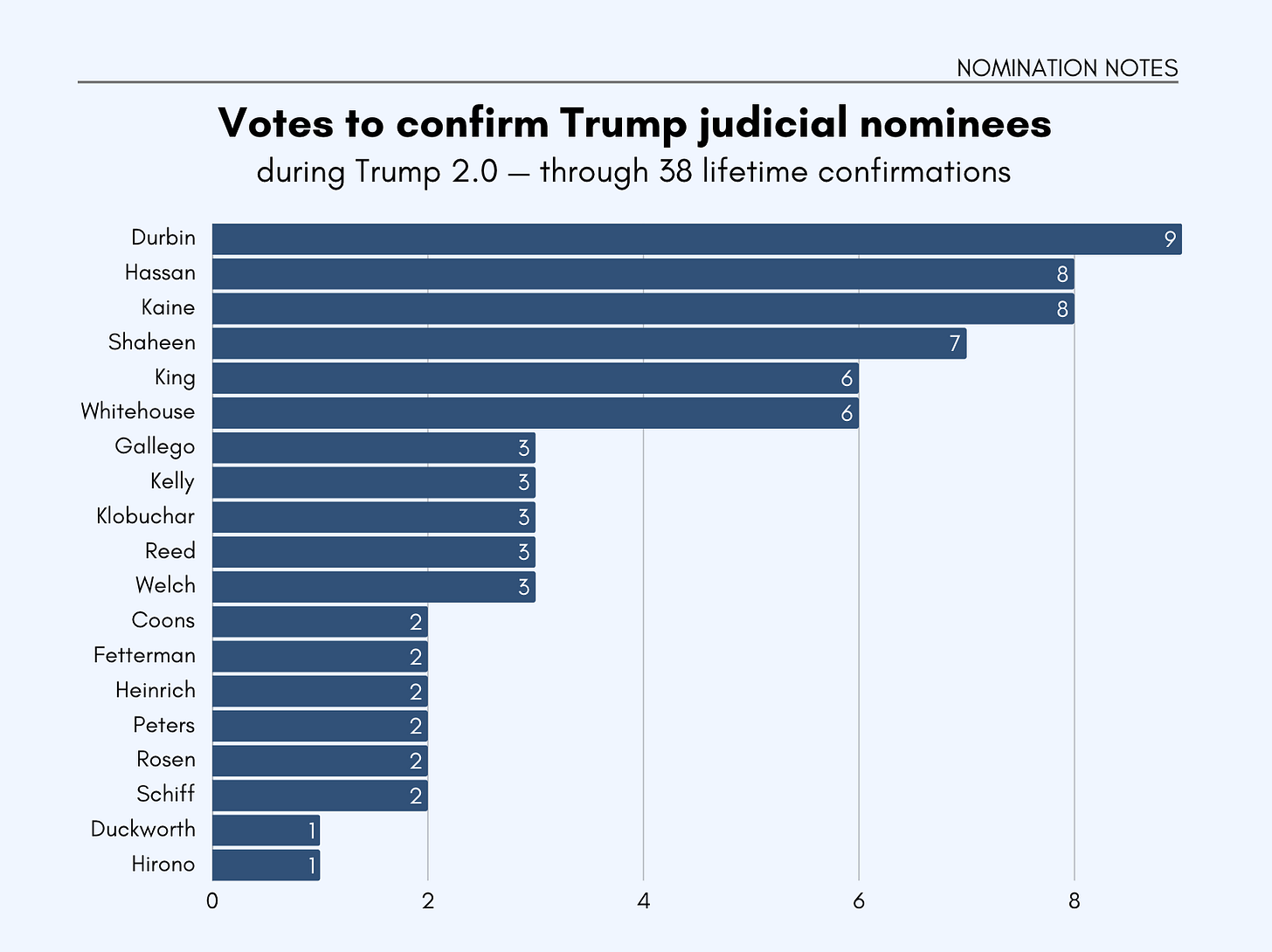
I am telling you all of this because, as of today, no Democratic senator has cast more votes in support of more Trump nominees than Durbin, who has voted to confirm nine of them to life-tenured judgeships. Among Democrats on the Judiciary Committee, Rhode Island Senator Sheldon Whitehouse—the caucus’s most dogged chronicler of the symbiotic relationship between the Republican Party and the conservative legal movement—is somehow right behind Durbin, with six yes votes. No other Judiciary Committee Democrat has more than three, and among them, only Connecticut’s Richard Blumenthal, New Jersey’s Cory Booker, and California’s Alex Padilla have yet to cast a single vote to confirm a Trump judge.
Patrick McNeil explains:
To date, 19 Senate Democrats — including the eight who voted for Clarke — have voted to confirm at least one of Trump’s lifetime judicial nominees during his second term.
During her confirmation hearing before the Senate Judiciary Committee, Clarke would not say who won the 2020 election — leading Senator Richard Blumenthal to call the nominees’ responses that day “Orwellian in their denial of reality.” He told all four nominees at the hearing that their answers were “an insult to this committee, but they also fundamentally show a complete lack of independence and backbone and impartiality, which are the fundamental requirements of a United States district court judge, or a judge on any panel.”
Senator Whitehouse also chimed in, saying “I hope you realize how ridiculous the four of you look — spouting these preposterous, canned answers in a forum in which, A, you’re supposed to tell the truth, and B, you’re supposed to demonstrate the judicial capacity to make independent, factual decisions in hard cases.”
Senator Whitehouse nonetheless voted to confirm Clarke today.
WHY I WANTED TO SHARE THESE STORIES
Words are easy. Actions matter. And one of the reasons I believe so many Democratic Party members are frustrated with their leadership is because of the chasm between our leaders’ words and their votes and actions.
Durbin and Whitehouse are asking the right questions. They are making an excellent point about how corrupt these nominees are before they take the bench. If they can’t answer questions about the January 6 insurrection or the winner of the 2020 election, we can’t really take them seriously as they claim to be impartial.
So, why would any Democrat vote to confirm obviously corrupt Trump nominees after all Senator Mitch McConnell did over the years to reshape the federal judiciary?
This is not the time for bipartisan comity. A refusal to acknowledge the reality that there was a violent insurrection against the United States government on January 6, 2021, and that Joseph Robinette Biden Jr., of the State of Delaware was elected president in 2020 should be disqualifying.
That means voting “no,” Senators. That shouldn’t be difficult to figure out.
#6
- Musk v. Altman proved that AI is led by the wrong people (Hayden Field, The Verge, Link to Article)
The tech trial of the year, Musk v. Altman, was ultimately a fight for control. Elon Musk argued that Sam Altman, with whom he helped found the now-massive company OpenAI, shouldn’t direct the future of AI. Altman’s lawyers, in turn, poked at Musk’s own credibility. A jury came to a verdict on Monday after just two hours of deliberation, dismissing Musk’s claims due to the statute of limitations.
In a strictly legal sense, three weeks of testimony added up to nothing. But the trial offered a more damning broader takeaway: Almost nobody in this saga seems worth trusting. Some of the most powerful people in tech seem temperamentally incapable of dealing with each other honestly. And if that’s true, it raises a bigger question: Why are they in control of a trillion-dollar industry that’s set to upend people’s lives?
<<snip>>
As one X user put it, “if untrustworthyness had mass, putting Musk and Altman too close to one another would collapse the courtroom and all of earth into a black hole.”
WHY I WANTED TO SHARE THIS STORY
The people leading the artificial intelligence large language model companies are not good people.
It is remarkable that they have been given so much leeway to lose so much money, jeopardize so many jobs, and harm so many local environments given how dishonest they are and how little they care about their fellow humans.
Trying to force their product on all of us isn’t working. I add -ai to the end of my Google searches so I don’t see the AI summaries that often include errors.
Now, I am not against large language models. I’m just against how they are being marketed to us and financed today. If any other industry demanded power with a product they suggested could destroy most white color jobs or has a real chance of ending civilization, governments would have stepped in long ago to put guardrails on them.
Instead, we are seeing Elon Musk, Sam Altman, and others rushing to cash in on IPOs before more businesses realize they can’t justify so much large language model usage once they have to pay full cost.
#7
- Stephen Colbert vs. The Lying Weasels (Craig Aaron, Pressing Issues, Link to Article)
I love a snarky monologue clip as much as the next guy, but if you had asked me a year ago who was going to be on the frontlines of the fight for free speech, I wouldn’t have guessed this bunch of middle-aged white dudes in fancy suits who specialize in couch-side banter.
As NBC’s Seth Meyers joked about Colbert’s departure during a cameo alongside his fellow late-night hosts in the finale: “Where will Americans turn to see a middle-aged white man make jokes about the news?”
As much as I might wish national attention was focused instead on the stories of Mario Guevara, Rümeysa Öztürk, Georgia Fort or even Sharyn Alfonsi, the most highly visible examples of government censorship and abject media surrender have been the attempts to suspend Jimmy Kimmel and cancel Colbert.
“The legacy of this show needs to be that we remember it as the show that was canceled because a presidential administration wanted it off the air,” Northwestern Professor Heather Hendershot told The Associated Press this week. “We haven’t connected every single dot on that, but it’s very clear that this was a political decision. And I think 20, 30, 40 years later, that is going to be strongly remembered about this show — that this was a moment of authoritarian triumph.”
WHY I WANTED TO SHARE THIS STORY
As a member of the Letterman television generation, I also love snarky monologues about current political and cultural events.
I do not love seeing major corporations bow down to unreasonable demands by an authoritarian government.
It is clear that Stephen Colbert’s Late Show was sacrificed so David Ellison’s Skydance could complete his purchase of Paramount. CBS News’ integrity is currently being sacrificed as Ellison seeks to close a purchase of Warner Bros./Discovery.
This is not how our government is supposed to work.
There will be a lot on Democrats plates when they win one or both houses of Congress this November and get the investigative gavels that come with a majority.
The Trump regime’s weaponization of the Federal Communications Commission needs to be on the list of investigations and reforms to ensure no future chairperson can act like Brendan Carr has since Trump returned to office.
Colbert is not the only victim. Given the list above, he’s not even the important one. But he is the one that can drive coverage and get more people to care. So let him be the entry point for the larger conversation we desperately must have as a nation.
#8
- What Rothko Represents Your Weather (Joonas Virtanen, Link to Website)
WHY I WANTED TO SHARE THIS WEBSITE
Because it is spectacular! I loved seeing what Rothko paintings best represented he the current weather in my location—and around the world.
I was a bit confused this morning when the painting didn’t seem to match the colors of the sunrise, but then I remembered I have night shift on my computer display to reduce blue light. Once I turned that off, everything made sense again. At least for a moment.
Useful Websites and Information Trackers
I Wanted to Share
Election Data
- 2026 Election Calendar (The Downballot, Link to Article)
- Ultimate Data Guide (The Downballot, Link to Article)
Iran War Consequences
- Strait of Hormuz Shipping Trackers (hormuztracker.com | hormuzstraitmonitor.com)
Trump Regime Authoritarianism
- Trump Action Tracker (Making Sense of US Politics, Link to Article)
- Executive Watch [Trump Abuses of Power] (Institute for the Study of Modern Authoritarianism, The Unpopulist, Link to Article)
- ICE Warehouse Tracker (Project Salt Box, Link to Article)
Trump Regime Corruption
- Kleptocracy Tracker Timeline (Anne Applebaum, SNF Agora Institute, Link to Article)
Follow me on BlueSky to see the stories I’m finding and the stories I’m sharing throughout the day.

From the Inaugural Address of President John F. Kennedy
In your hands, my fellow citizens, more than mine, will rest the final success or failure of our course. Since this country was founded, each generation of Americans has been summoned to give testimony to its national loyalty. The graves of young Americans who answered the call to service surround the globe.
Now the trumpet summons us again—not as a call to bear arms, though arms we need—not as a call to battle, though embattled we are—but a call to bear the burden of a long twilight struggle, year in and year out “rejoicing in hope, patient in tribulation”—a struggle against the common enemies of man: tyranny, poverty, disease and war itself.
The Long Twilight Struggle is free and supported voluntarily by its readers. If you liked what you read and can afford it, please consider becoming a paid subscriber! Or, if you prefer, feel free to buy me a coffee using the tip jar.