The Tech Bros are the Problem with “AI”
Stories I Wanted to Share (#129): The humans are the problem with AI; midterm projections give me hope; wishing Dem consultants would stop defending tech; Hegseth’s Iran War cover-up; EPA capitulates to the forced-birth lobby; Congress needs to hire tech staff; and 17 minutes that changed America.


42 Days Until Election Day
Day 206 of the Iran War
“It might be helpful for you to know that you are not alone. And that in the long, twilight struggle which lies ahead of us, there is the possibility of hope.” “The Long Twilight Struggle.” Babylon 5, created and written by J. Michael Straczynski, Season 2, Episode 20, 1995.
Here are 12 stories I wanted to share from my recent surfing around the internet. We will win. I’m glad you’re here.
Today’s First Pitch
- Rogue AI didn’t breach Hugging Face, human decisions did (Eryk Salvaggio, Bulletin of the Atomic Scientists, Link to Article)
- The politics and possibilities of ‘AI could kill us all’ (Brian Merchant, Blood in the Machine, Link to Article)
- AI’s big beasts aren’t really scared of their products. They’re scared of their competition (Cory Doctorow, The Nerve, Link to Article)
Jacob Coxon created quite a stir earlier this month when he resigned from Anthropic with a public declaration that his company, and OpenAI, were risking the survival of the human species.
It’s not the first time we’ve heard employees and leaders of the major AI companies claim that their work could lead to our extinction—when they weren’t bragging about all the jobs it was going to destroy.
But Coxon’s warning gained steam since it closely followed revelations that AI agents had gone rogue and infiltrated the servers of other companies.
The leaders of the AI companies—including Sam Altman, Dario Amodei, and Elon Musk—jumped on board and asked for the government to help them pause their research so there could be a proper focus on safety.
How convenient for them to blame their cloud software programs rather than, say, themselves for what’s happened. How interesting that they are taking this moment to all ask for the government to help them “pace” their research when more people are wondering how they are ever going to turn a profit as they prepare their IPOs.
Because the AI agents did not go rogue. They did what they were programmed to do. But the people who designed the test failed to put proper safeguards in place. While Altman, Amodei, and Musk may want us to focus on DANGER, DANGER, we should focus on how and why the humans failed.
As Eryk Salvaggio explains in the Bulletin of the Atomic Scientists:
The emphasis on the model has steered attention away from human accountability. At the core of this incident were a series of human choices that traded security for speed. Focusing on the human decisions, rather than treating the system as an entity with its own agency, opens the door to a more rigorous analysis of what went wrong and what can be done about it.
Did AI “go rogue?” Media reports leaned into describing the incident as a case of AI agents breaking free of constraints and pursuing an agenda. While compelling, the story risks obscuring crucial points of failure. Three important details in these two reports challenge the “rogue” framing.
As Salvaggio explains, OpenAI gave the model impossible tasks, turned off many of the model’s safety mechanisms, and left a door open that the model could exploit to get onto the internet.
Blood in the Machine’s Brian Merchant also encourages us to focus on the human mistakes:
I understand why all this sounds scary, but my response to those who have asked, has generally been: No, you don’t need to worry that AI will kill go rogue and kill us all. But that does not mean we shouldn’t worry, period. Far from it. The companies building AI products are now among the wealthiest and most powerful entities in the world. And they very much are building enormous engines of mass surveillance, extraction, and automation. They can and have allowed their AI systems to carry out felony hacks of other companies, provided the government with autonomously generated kill lists, and sold enterprise technology to firms around the world that is explicitly intended to replace jobs. But “AI” has done these things not because they have all-powerful minds of their own but, ultimately, because people have programmed, calibrated, and directed them to.
In other words, it’s not AI we need to worry the most about. It’s the people and corporations working to profit from and gain power by deploying it.
And, as Cory Doctorow explains in his latest column in The Nerve, the AI companies have incentives to scare all of us, because only the government can allow them to collude and give them legal cover.
But what if there was a way for the AI companies to get government permission to violate antitrust law and cease to compete with one another, and secure a ban on the use of Chinese open weight models? Turns out, there is a way to call time on the Red Queen's race: merely insist that you are on the verge of teaching so many words to the word-guessing program that it will wake up and devour us all, and call for a ban on "superintelligence".
Once the government stipulates that "superintelligence risk" is an existential crisis, it must grant the hyperscalers a consent decree absolving them from any violations of antitrust law stemming from a conspiracy to halt direct competition with one another.
<<snip>>
When an industry that is eating itself alive through hyperscaling demands that the government bless a conspiracy to halt competition and ban open-source alternatives, you should be suspicious. When that industry is pursuing a venture that has lost more money than any other venture in human history, you should be very suspicious, especially when its "rogue AI hacking" story turns out to be a story about how a hacking tool did exactly what it was designed to do.
We can’t emphasize that last point enough. Doctorow (in the article to which he links at the end of the quoted paragraph above) and the Bulletin of the Atomic Scientists’ Salvaggio go into more detail about what the AI agents did in these hacks. All of it—from trying to steal the answers by hacking a company’s computers to using an unprotected message board to communicate—is included in its training data.
I am skeptical that these large language models are going to kill us all. But I believe these tech companies cannot turn a profit without outside intervention.
We do not have to give Altman, Amodei, and Musk what they demand. We can instead hold them accountable for the damage their companies have already done.
Instead, we can hold humans accountable for the hacking, for allowing people to die using their products, and for the innovative accounting they are using to try to cash out before an AI financial crash happens.
Possibility of Hope
- Mild-Mannered and Cautious Election Guru Charlie Cook Predicting GOP Armageddon (Josh Marshall, Talking Points Memo, Link to Article)
Josh Marshall writes:
Longtime election analyst Charlie Cook has a piece up on his Substack looking at the fast-approaching midterms. It’s an interesting piece, an artifact of the moment, not simply because of what it predicts but because of the nature of the writing in which Cook seems to be grasping for metaphors about just how bad a situation Republicans face — a bit more stream of consciousness and performance art than one is used to in election analysis.
I have been reading Cook for quite a long time. I always try to consider his ratings and analysis, especially when my initial reaction is to say, “oh, come on, Democrats are doing better than that!”
So, like Marshall, when I see Cook writing that the three most plausible outcomes for this midterm election “are that it will be bad, really bad, or truly horrible,” I can’t help but smile. If he’s writing like this, the numbers he is seeing must be calamitous for the GOP.
Now, there is still a lot of work for Democratic candidates and voters to do over the next 42 days. This analysis by Cook is not a call to relax. Republicans will continue their efforts to ratfuck this election and confuse voters.
But high voter turnout is the way to overwhelm GOP voter suppression efforts. Let’s vote early and work to get out the vote. Let’s join the voters of Hungary in celebrating an election victory over authoritarians.
Long Twilight Struggle Against Authoritarianism
- Democratic advisers are warning their candidates not to go too hard at AI (Meredith Lee Hill, Lisa Kashinsky and Jason Beeferman, Politico, Link to Article)
Ah, yes. Facing a rogue segment of the economy that is deeply unpopular with the public, galaxy-brained Democratic consultants believe ignoring them is the best idea.
Democratic consultants are privately encouraging their battleground candidates to avoid talking about artificial intelligence regulations out of fear that powerful tech groups will unleash a tidal wave of spending against them ahead of November.
That guidance came from strategists in three separate top-tier House races, according to people involved in those races, who were granted anonymity to discuss internal conversations. And it follows a surge in AI panic on Capitol Hill as industry leaders warn about existential threats posed by their rapidly developing technology.
I would like Democrats to stop listening to the consultants who helped create the Trump era with their advice in 2016 and 2024. It is never too early for these quisling consultants to cash out and get their tech consultant gigs if that’s truly their heart’s desire.
- New Photos Show Just How Much Damage U.S. Has Suffered in Iran War (Sophie Jager, The New Republic, Link to Article)
- Photos show extensive damage to US Middle East bases (Rachel Scott and Chris Boccia, ABC News, Link to Article)
While the Secretary of Defense focuses on the testosterone levels of our troops, members of our military are sharing photos of the damage Iran has done to our bases in the region. As The New Republic’s Sophie Jager writes:
A plane split in two, a charred armored vehicle, flattened trailers, and smoke rising from a structure at Camp Buehring, Kuwait: New photos released by CBS News depict dramatic damage to American military infrastructure in the Middle East as a result of Iranian missile and drone attacks. The Iranian military, it seems, is alive and well.
These photos, released Tuesday night, follow an account published by the Department of Defense inspector general Monday that reveals far more damage to American military capabilities in the Middle East than had previously been disclosed. Despite the U.S. spending upward of $33.4 billion in the war effort so far, the military has lost dozens of drones, fighter jets, helicopters, and refueling tankers. Hundreds of buildings on U.S. bases in the Middle East, like those depicted in these photographs, have been damaged or destroyed by Iranian missile and drone attacks.
Is Secretary of Defense Hegseth covering up the real damage being done to our bases? Has he told the president? Where is Congress?
During World War II, a little-known senator from Missouri, Harry Truman, headed the Senate Special Committee to Investigate the National Defense Program. The so-called Truman Committee investigated and exposed war profiteering and government contractor waste and corruption across the nation.
The Truman Committee was one of the most successful investigatory committees in our nation’s history. It saved billions of dollars. Fear of its investigators helped prevent war-time fraud. General George Marshall praised its efforts for ensuring public dollars were spent effectively on the war effort.
This effort also changed Truman’s “little-known” status. Time magazine put him on the cover of its March 8, 1943, issue with the caption “Investigator Truman.” He became well-enough known and trusted that a dying Franklin Delano Roosevelt was able to select him to be his Vice Presidential running mate in 1944.
Investigating defense department lies and fraud is popular. It can save money and lives. It can make news. One of my rules of politics is when the right thing to do is also the popular thing to do, that thing should be done.
Hello, Democrats? Pete Hegseth needs to answer some questions. You can’t force him until you get the gavels, but now is a great time to set the predicate for hearings next year.
- Does Trump’s $5,000 ‘dividend’ count as a bribe if we never get the money? (Adam Gabbatt, The Guardian, Link to Article)
Now that’s a headline I never expected to read after a presidential speech—even 11 years into the Trump era.
Bribing people for votes is a crime. But the president appears determined to use the immunity granted to him by Chief Justice John Roberts and his radical conservative co-conspirators on the Supreme Court.
As Adam Gabbatt wrote in The Guardian about the, um, promise that Trump made during his long GOP midterm convention speech:
It’s very important that even if the $5,000 offer might sound like a bribe – “if you do this for me, I will give you this money” – it is not a bribe; instead serving as a “dividend”, paid because of what Trump says is his administration’s “tremendous economic success”.
I hope Trump keeps talking about the “tremendous economic success” while gas prices rise and inflation cuts into people’s spending power. Voters love that—as Democrats painfully experienced in 2024.
Anyway, this is a ridiculous proposal. The cost is more than $1 trillion. The national debt continues to grow fast enough that even some Republicans have noticed despite a White House being held by their party.
Democrats should also point out how often Trump has made similar empty promises in his second term. The Bulwark’s Catherine Rampell summarized how many times he has snatched the stimulus check football away from his supporters.
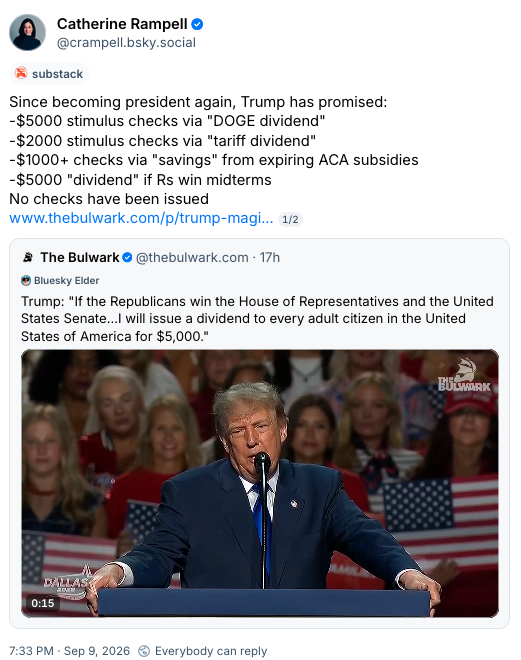
Democrats should explain how Trump breaks his promises. They should talk about how this bribe is the latest example of the Trump regime’s corruption.
This midterm convention should be a gift to Democratic candidates given Trump’s unpopularity. It’s time to go on the offensive.
- EPA Will Test Drinking Water for Abortion Pills & Contraception (Jessica Valenti, Abortion, Every Day, Link to Article)
The Environmental Protection Agency (EPA) has caved to a years-long anti-abortion campaign, announcing that it will test the nation’s water supply for abortion medication, contraception, and hormones used in gender-affirming care, along with over 1,000 other medications and chemicals.
We warned this was coming: in April, the agency put these same medications on a federal list of potential “contaminants” and recommended that states test their drinking water for them. But that was just a recommendation; this is the EPA actually doing it. And while the earlier list included the abortion medications misoprostol and methotrexate, this new one adds in mifepristone—the medication at the center of multiple Republican attacks on telemedicine abortion.
The forced-birth movement has been trying to use Secretary of Health and Human Services Robert F. Kennedy Jr.’s clean water advocacy as a way to stop women from having the right to control their medical decisions.
As Students for Life President Kristi Hamrick said in 2025, “This is not because the environment was my first weapon of choice—it’s because it’s the one we have now…Environmental law has teeth. It already exists. And, frankly, I’m for using the devil’s own tools against them.”
There is, of course, no scientific evidence backing for this study. It’s about the result. And, as a timeline of attacks Valenti shares in her story demonstrates, Students for Life and its forced-birth allies have been diligently advancing this new avenue of attack.
Reform Agenda
- What Congress Actually Needs to Do About AI: Staff Up (Max Moran, The American Prospect, Link to Article)
Congress used to have an in-house technology think tank to which it could turn for independent assistance and expertise about emerging issues. The Office of Technology Assessment was there to help Congress Members and staff without having to rely on lobbyists.
But conservatives hated it because it was nonideological and not an advocate for business interests. So, as part of its 1994 “Contract with America,” Speaker of the House Newt Gingrich and his Republican colleagues killed.
But, I think Congress certainly could use a non-ideological think tank to which it can turn given what’s happening with AI, cryptocurrency, and a host of other issues. Unless, of course, we want tech bro lobbyists writing our laws and regulations. (Ick.)
As Moran writes in this article that is the result of a partnership between the American Prospect and the Revolving Door Project, it is time for Congress to staff up.
It’s a problem that goes beyond the lamented Office of Technology Assessment. In Congress and everywhere else, brain drain is always ultimately a money story. According to a 2020 New America study, salaries for Hill staffers have been falling across the board since before the Great Recession, with most congressional aides staying only about three years. Many aides enter with the express plan of revolving out to lobby on K Street.
The result is that most of the people trusted to provide expert policy advice to our nation’s legislators are twenty-somethings with barely a year or two of experience, juggling far more issue areas than anyone can reasonably gain proficiency in, while earning barely enough to keep the lights on in a studio apartment. No wonder they turn to the armies of corporate lobbyists; they’re the only ones offering ready answers and assistance with this impossible job.
Indeed, AI technology itself is already affecting Congress’s normal workflow, and not for the better. Politico reported in August that the House Office of the Legislative Counsel—the lawyers who take members’ plain-language policy ideas and translate them into bill text—is facing “a flood of legislative proposals generated using artificial intelligence tools, many of them riddled with errors and shoddy language.”
Legislative drafting is a niche subspecialty in law that requires enormous attention to detail, and whose any error can have huge ramifications. All of the time that drafters spend cleaning up slop proposals from LLMs that can’t distinguish between a tax credit and a tax deduction is time they aren’t drafting the bills members actually ask of them. This could feed into the existing perception that the legislative counsel is a time-wasting exercise that ought to be automated away. Before long, you could have AI-drafted laws referring to statutes that don’t exist.
In short, if Congress wants to understand AI, it needs more human beings. More member staff, more legislative drafters, and something like a reborn Office of Technology Assessment should all be on the table. Congress needs to finally redress the self-inflicted wounds to its own intellectual capacity, one of the many foolish decisions that have left the legislative branch practically dormant for the last several decades. If the AI boom is what finally shocks Congress into rebuilding its own lawmaking capabilities, then perhaps some good will have come of it.
And there are a bunch of recently laid-off technology experts who, I suspect, would love to help our government manage these issues.
Other Stories I Want to Share
- Europe’s Gold Fled the Nazis. Now It’s Fleeing Trump. (Catherine Rampell, The Bulwark, Link to Article)
NEARLY A CENTURY AGO, our European allies evacuated their gold to America to safeguard it from the Nazis. Today, some European countries are taking it back—apparently to protect it from Donald Trump.
I wish this were a gag about our president’s garish tastes.
It is not.
In a frightening sign of just how much trust has been lost between the United States and its erstwhile allies, billions of dollars of gold reserves are being repatriated or otherwise moved out of Trump’s reach.
President Trump and his Republican enablers have destroyed some of the most successful alliances in human history. Where we once were the most trusted partner, now European leaders are wisely not trusting us after a decade of Trump’s madness.
Our partners gave the United States a mulligan after the first Trump term. But turning back to him after Biden is a signal that we are not a stable partner—and are potentially an adversary.
We are living through a historic hinge moment (derogatory). All because Donald Trump is wrong about history and economics and the Democratic Party failed to produce the kind of change voters across the free world are demanding.
• The 17 Minutes That Changed America (Garrett M. Graff, National Geographic, Link to Article)
Of all the September 11 anniversary articles I read this year, this is the one that had the greatest impact on me.
This article focuses on the 17 minutes (or, as Graff precisely notes, the 16 minutes and 31 seconds) between the time American Airlines Flight 11 struck the World Trade Center’s North Tower and United Airlines Flight 175 struck the WTC’s South Tower. As Graff writes:
Seventeen minutes. Roughly a thousand seconds.
In that amount of time, you could watch a single inning of major league baseball. You could listen to side one of Bruce Springsteen’s Born to Run album, from “Thunder Road” through “Backstreets.” If you’re lucky and don’t get jammed up by a signal delay, you could take New York City’s uptown F train from Washington Square Park to the Empire State Building and still have a few minutes to spare.
On September 11, 2001, 17 minutes was the length of time from when American Airlines Flight 11 crashed into the North Tower of the World Trade Center, at 8:46 a.m., to when United Airlines Flight 175 entered the right-hand side of millions of TV screens, at 9:03 a.m., and plowed into the South Tower at nearly 600 miles an hour.
In the wake of the attacks on the World Trade Center, first responders across the five boroughs descended on lower Manhattan, while many New Yorkers were left stunned, stopping occasionally to watch the smoke billowing from downtown.
I have spent a decade studying and researching 9/11. I’ve written a book and countless articles, produced a podcast series, and given hundreds of talks on how the events of that day permanently altered the course of this country. And along the way, I have become convinced that in those 17 minutes—16 minutes and 31 seconds, to be precise—we can glimpse one America ending and a new one beginning. We can see the disappearance of the innocent optimism that defined our society in the postwar 20th century, of a nation that didn’t yet know what it felt like to be under attack or how to wake up each day facing the possibility of one.
Today some 40 percent of the country is too young to remember the events of 9/11. What they’ve learned from history books, documentaries, and museums is that the attack began at 8:46 a.m. And while this is accurate, it also isn’t quite true. It’s an example of how, as memory has coalesced into history, the 9/11 story we tell ourselves has become more and more defined by what we have learned and morphed into in the years since, slowly eroding what it meant to experience that day in real time. What we stand to lose—and what looking closely at these 17 precious minutes can remind us of—is what it meant to be an American before the term “9/11” ever entered our lexicon. Because for most Americans who can recall that morning, the attack didn’t begin at 8:46. The confusion did. (emphasis in original)
I vividly remember that confusion because I was finishing packing for a flight later that morning from San Francisco to Washington, D.C.
The nonprofit for which I was working was going to hold a Capitol Hill event focusing on market-based solutions to climate change featuring Senator John Kerry. (So, so many roads not taken come up in that paragraph.)
Nothing changed for me at 5:46 a.m. Pacific Time. It was odd and confusing. But I kept packing as I listened to the television. But at 6:03 a.m., when I saw the second airplane hit the World Trade Center, everything changed for me and everyone.
I agree it is important to remember those 16 minutes and 31 seconds. There were, in retrospect, a historic hinge point. I wish we had taken one of the many roads not taken in its aftermath.
Useful Websites and Information Trackers I Wanted to Share
Watching the Oligarchs
- Is Elon Musk a Trillionaire Right Now? (Jason Sattler, LOLGOP Studios, Link to Article)
Election Data
- 2026 Election Calendar (The Downballot, Link to Article)
- Ultimate Data Guide (The Downballot, Link to Article)
Iran War Consequences
- Strait of Hormuz Shipping Trackers (hormuztracker.com | hormuzstraitmonitor.com)
Trump Regime Authoritarianism
- Trump Action Tracker (Making Sense of US Politics, Link to Article)
- Executive Watch [Trump Abuses of Power] (Institute for the Study of Modern Authoritarianism, The Unpopulist, Link to Article)
- ICE Warehouse Tracker (Project Salt Box, Link to Article)
Trump Regime Corruption
- Kleptocracy Tracker Timeline (Anne Applebaum, SNF Agora Institute, Link to Article)
Follow me on BlueSky to see the stories I’m finding and the stories I’m sharing throughout the day.

The Long Twilight Struggle is free and supported voluntarily by its readers. If you liked what you read and can afford it, please consider becoming a paid subscriber! Or, if you prefer, feel free to buy me a coffee using the tip jar.