No Kings Matters (#121)
In this edition: five stories with 13 links I’ve recently found interesting about where things stand in our long, twilight struggle to defeat authoritarianism. Why No Kings matters; Trump’s incoherent thoughts about Iran; a UC-Irvine professor wins her profession’s top honor for research Americans refuse to believe; California Democrats in danger of losing gubernatorial election; and a way California legislators could pull an emergency cord to prevent that outcome.
Here we go. We will win. I’m glad you’re here.
“It might be helpful for you to know that you are not alone. And that in the long, twilight struggle which lies ahead of us, there is the possibility of hope.” “The Long Twilight Struggle.” Babylon 5, created and written by J. Michael Straczynski, Season 2, Episode 20, 1995.
#1
- Does “No Kings” Matter? (Andrea Pitzer, Degenerate Art, Link to Article)
- Eight Million Protestors and No Kings: The Case for Showing Up (Rebecca Solnit, Meditations in an Emergency, Link to Article)
- What naysayers don’t get about ‘No Kings,’ the biggest protest in U.S. history (Will Bunch, The Philadelphia Inquirer, Gift Link to Article Made Possible By Subscribers)
- No Kings Protests Failed To End Fascism on Saturday. Curious. (Denny Carter, Bad Faith Times, Link to Article)
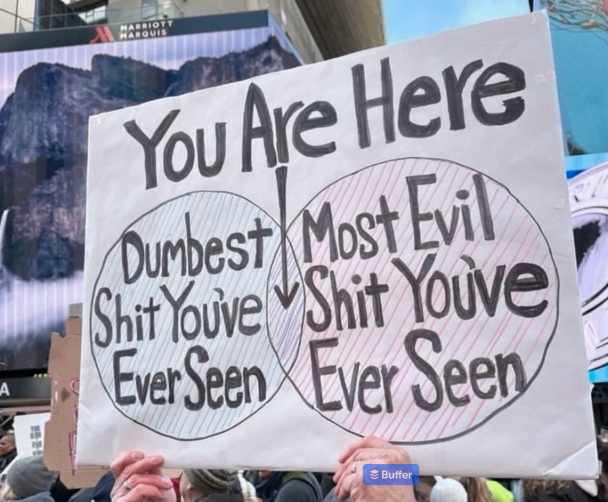
Congratulations to everyone who attended or supported the largest single-day protest event in modern U.S. history on Saturday.
Protests happened on all seven continents (yep, including Antarctica). I also loved seeing how many new protests happened in deeply red areas of the country. It takes courage to put yourself out there in a red area. But doing so exposes people to the arguments—and shows others that they are not alone in their feelings of distress about the Trump regime.
These visible signs of protests are significant for many reasons. As Andrea Pitzer explains:
But I think that something bigger is afoot—something that’s easy to miss. I’ve written repeatedly in this newsletter since November 2024 about the two things that have helped countries reverse course once they’ve become concentration camp societies. One is the existence of at least a partially functioning, semi-independent judiciary. The other is keeping the right to public dissent.
<snip>
The 8-million-plus demonstrators who took to the streets on Saturday also understand that public dissent is not only a performative ritual but also a direct blow to the dictatorial authority that Trump has assumed. They’re reclaiming the power that they’ve ceded to others in the past. In the same way, first-time protesters are practicing for the harder tests that may be coming. In the wake of the murders of Porter, Good, and Pretti, the risks are clearer now.
They’re girding themselves to help because we know where authoritarianism goes and how far it will stoop to acquire more power, even after having seized so much. The greater the number who stand up now, the fewer the number who will have to pay with their lives later.
Some experts tried to downplay No Kings because of a lack of a cohesive agenda. That’s not the right way to think about these protests. Fighting back against an attempt at authoritarian capture requires many strategies.
Plus, how are activists and organizers created? For many, it’s through exposure to events like these. As Rebecca Solnit explains:
Tim Hjersted wrote a piece called "How To View Protests Like an Organizer "in response: "These critiques come from people who consider themselves more radical than the average protester. They carry a tone of world-weary sophistication. The implication being that those who show up are naive, and those who stay home see the bigger picture. Here’s the problem: this attitude is strategically illiterate. It mistakes cynicism for analysis. And it guarantees the one outcome its proponents claim to fear most: a movement that never escalates beyond what it already is. An organizer looks at a mass protest and sees something completely different. Where the cynic sees a feel-good spectacle, the organizer sees thousands of people ready to get involved — a chance to connect them with local groups, deepen their engagement, and build the relationships that every form of deeper resistance depends on."
He continues, "Protests rarely achieve their maximalist demands on their own. But they do things nothing else can: they shift public discourse (Occupy didn’t break up the banks, but the language of the “99%” permanently changed how Americans talk about inequality), they energize waves of downstream organizing (the Women’s March fed directly into the candidate recruitment and voter mobilization that flipped the House in 2018), they build relationships between people and groups who might never have connected otherwise, and they make visible the scale of opposition in a way that no online petition or social media post ever will."
But also what's wrong with feeling good? "Joy doesn't betray but sustains activism. And when you face a politics that aspires to make you fearful, alienated and isolated, joy is a fine initial act of insurrection," I wrote a while back. Timothy Snyder posted, "I was at a #NoKings rally yesterday and rather than writing another essay about why this matters I will just say that it is pure joy to meet the people who want to stand out and the people who are doing the work. Thank you."
Joy? In this economy? During a time when authoritarian leaders are rising around the world? While the Trump regime creates greater problems through its policies and by waging a war in Iran without an apparent strategy to win it?
Yeah, moments of joy are vital. Sometimes, having fun is a proper resistance strategy. The Philadelphia Inquirer columnist Will Bunch also picked up on the good vibes:
There were loud echoes from the 1960s in the peace signs and “No War” placards carried by marchers who’d been a tad too young for Vietnam, yet one also waved the “Gen Z revolution” flag of the straw-hatted pirate from the popular anime One Piece. Not to mention the matching-costumed eight-foot “Dinosaurs for Democracy” with their campaign sign, “Giant Meteor 2026.”
Sure, the demonstration was primarily about the war in the Middle East that costs nearly $2 billion a day and yet lacks congressional approval, and the secret police brutality of the regime’s immigration raiders, and the big spike in healthcare costs, and the cover-up of the Jeffrey Epstein files, and the massive grift. But for a few hours on a sunny yet bitterly cold Pennsylvania Saturday in late March, it was about more than the sum of its parts — it was something spiritual.
Later in his column, Bunch also discusses how organizers are looking to escalate their actions in April, leading to a general strike on May 1. Things are moving forward.
There will always be detractors to any movement in a country as large as ours. But I think many of the arguments made against the value of holding No Kings events are often made in bad faith. Which is why I was glad to see Bad Faith Times Denny Carter take on the naysayers with an appropriate level of disdain:
That the largest single-day protest in the history of the United States was not a hyper-disciplined left-wing organizing machine making specific policy demands of a government that has eroded basic freedoms doesn’t really matter. That the anti-constitutional government remains in place today is no surprise. This isn’t Europe. We don’t have snap elections. We don’t have any of the good shit that comes with a parliamentary system. We have two goddamn parties captured by capital to varying extents and elections every couple years. That’s what we have right now. That’s what we have to work with.
Saturday’s No Kings rallies across the US drew between 8 and 9 million people who engaged in something that matters beyond political strategizing or immediate, tangible victories for Americans who would like to save representative democracy and self governance: These folks saw each other, face to face, not online, not on TV. They looked at each other and they shared their mutual fear and loathing of the Trump regime; they did not feel bad about harboring such disdain for rulers who deserve nothing but disdain and derision. They danced and smiled, and for an hour or two or three, extracted themselves from the bleakness and sadness of our current moment.
The machines in their pockets armed with sadness algorithms couldn’t touch them here. At No Kings rallies they saw up close that they are not alone – far from it, in fact – and that the median pro-democracy American has changed dramatically since the shock of 2016.
No, this round of protests won't lead to President Trump’s immediate removal from office. They did not stop, as Carter observed, “the international fascist movement in one afternoon.” But that's an unfair expectation that only a pundit in an air-conditioned studio or an online shitposter could create.
It has taken decades to get to this point. So that it will take more than three No Kings events to reverse the trend in a country with a fixed election schedule is unsurprising.
Yes, we need more types of action—but the lead organizers of the No Kings events have already announced ways to escalate the resistance to the Trump regime.
We are going to win. It will be hard. But that’s why building community matters in a fight against an authoritarian—and why joy is also a necessary ingredient.
#2
- March 19-21: God is a comedian (NO1, Gold and Geopolitics, Link to Article)
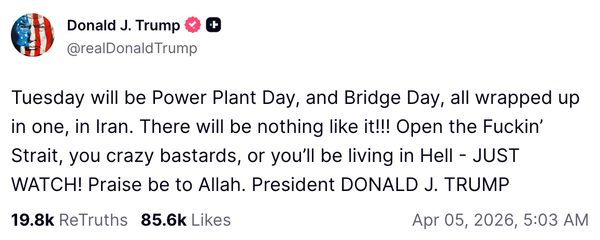
Since the beginning of the Iran War, reality and President Trump have also been in conflict. It is not going well for the president—and his speech last night did not help his argument.
What is happening in Iran is what happens when a president has surrounded himself with people who won’t point out difficult facts and when members of the Dear Leader’s party are physically afraid to disagree with him.
But unlike Congressional Republicans, Iran’s regime leadership is willing to tell Trump “no.” Regime change may have been Trump’s dream, but instead the Iranian government remains in place—and has a stronger hold on power now than it did at the beginning of the year.
It is obvious that the Trump regime did not consider how Iran had a major strategic advantage in the current conflict—the ability to blockade the Strait of Hormuz. The Trump regime was not ready for that (obvious) response or the economic pain it would create for the United States and its allies around the world.
So now Trump is in free association mode, hoping to once again happen upon a fortunate solution for which he can claim credit. It has led to a series of bizarre, even from Trump, moments.
As the anonymous writer No1 explained a couple of weeks ago in the Gold and Geopolitics newsletter:
This week, the US Treasury lifted all oil sanctions on Iran. For 30 days. 140 million barrels of Iranian crude, sitting on ships at sea, may now be sold freely on the global market. Including to the United States itself.
In yuan.
The United States is purchasing, with Chinese currency, oil from the country it is currently bombing?! The same oil that funds the missiles that just shot down an F-35 for the first time. The same missiles that are redecorating allied oil infrastructure.
Treasury Secretary Bessent called this “narrowly tailored”. Narrow like in white, and tailored as in card, apparently.
In the same OFAC filing, Russian oil sanctions were lifted as well. And Belarus potash too, because apparently the universe was running low on irony and needed to top up.
The logic, insofar as there is any, goes like this: the war has crashed the global oil market so hard that the administration needs the enemy’s oil to keep gasoline prices from eating the midterms. They are unsanctioning the people they’re bombing because the bombing is working too well at the thing they didn’t want it to do. The sanctions were necessary to stop Iran funding the war, but the war made the sanctions too effective, so the sanctions had to be lifted to fund the war effort against the country that no longer needs sanctions because the oil revenues that sanctions were preventing are now required to prevent the economic damage caused by preventing those revenues, which is itself a consequence of the military campaign designed to make the sanctions unnecessary by making Iran the kind of country that doesn’t need sanctioning, which it would be, if the sanctions hadn’t been lifted to pay for making it that.
The United States has lifted sanctions on the country with which we are at war because spiking gas prices create political problems. Not to mention the challenges created by spiking fertilizer prices. Or a helium shortage.
Moreover, the country with whom we are at war refuses to negotiate because the last time they did, those negotiations ended up being cover for the launching of air strikes.
Iran is saying no. Trump tries to bend reality to his whims. He’s failing. As No1 writes:
Trump asked NATO to send ships to help secure the Strait of Hormuz. Every. single. ally. refused. Trump called them “cowards” and said NATO has a “very bad future”. He then announced that the United States doesn’t actually need the Strait of Hormuz. He then said countries that do need it should police it themselves. He then told China to police it. He then sent 5,000 Marines toward it.
This sequence of statements was delivered, as far as the public record shows, by the same person, using the same mouth, within roughly 24 hours. The allies are cowards for not helping with the thing he doesn’t need, which is why he’s sending Marines to die for it, unless the countries that do need it do it themselves, which they won’t, because they’re cowards.
Trump told reporters the strait could be opened with a “simple military maneuver” that is “relatively safe” but requires “a lot of help”. Help. From the cowards. Who he doesn’t need. For the strait. That he also doesn’t need.
That’s not a weave. It’s incoherence. The emperor has no plan. Throwing ideas at the wall is not improving the situation. Media sanewashing isn’t going to get Trump through this self-inflicted crisis.
Plus, even if Iran were interested in negotiations, how do they negotiate with a president who uses stream of consciousness to “manage” his foreign policy? Here No1 summarizes a recent Trump press gaggle with reporters:
Friday’s press gaggle. Barely exaggerated: at 12:03 PM, President Trump told reporters he wanted a ceasefire with Iran. At 12:05 he declared victory. At 12:07 he announced he was sending Marines. At 12:08 he said no boots on the ground. At 12:11 he said he did not want a ceasefire. At 12:16 he declared victory again. At 12:17 he asked for a ceasefire. At 12:23 he told NATO they were cowards. At 12:29 he said Iran was begging for a ceasefire. At 12:31 he said everything was perfect. At 12:36 he said $500 oil was a good thing. At 12:37 he demanded Iran open Hormuz. At 12:39 he said Hormuz was never closed. At 12:41 he said the US was not at war with Iran. At 12:42 he declared victory in Iran.
By 3:43 PM he told CBS he doesn’t want a ceasefire. By 5:13 PM - 13 minutes after futures markets closed for the weekend, in a coincidence that should be studied in every securities fraud textbook - he posted on Truth Social that the US is “getting very close to meeting our objectives as we consider winding down our great Military efforts”. The S&P reversed more than 1% in seconds. QQQ had already surged 1.1% in the 80 minutes before the announcement, with call options flowing in at a pace that suggests someone, somewhere, had an itinerary.
How was this contradictory—and scary—performance not the news of the weekend? Trump’s speech last night offered more of the same incoherence. How are Republican elected officials not being forced to explain why they think this is okay—particularly in a time of war?
A decade of Republican and media sanewashing of Trump’s statements has created a reality distortion field around the president. But we are not required to live within it. And the Iranian regime has chosen to stick to reality.
And now the best-case scenario is for the U.S. to ensure Iran reopens the Strait of Hormuz—the situation that existed before Trump and Netanyahu started this war.
It does not make sense. None of this is normal.
#3
- A UC professor won criminology’s highest honor. Americans still don’t believe her research (Raheem Hosseini, San Francisco Chronicle, Link to Gift Article Made Possible By Paid Subscribers)
Charis E. Kubrin thought it could be a prank.
The UC Irvine professor had gotten an email telling her she was nominated for the Stockholm Prize in Criminology, an accolade that amounts to her field’s version of a Nobel Prize. After 20 years of studying and writing about immigration and crime — and specifically how immigration does not make crime go up — Kubrin was used to seeing dismissive, sneering and even misogynistic takes in her inbox. This was different.
“I remember literally running into my husband’s office and saying, ‘Come look at this email, I think I’m being punked,’” she recalled.
She wasn’t.
In November, the Stockholm Prize in Criminology Foundation named Kubrin and Vanderbilt University professor Mark W. Lipsey, a scholar on effective rehabilitation methods, as recipients of an annual prize for deepening the world’s understanding of crime, what and who cause it, and effective and humane ways to respond. In Kubrin’s case, she was being recognized for rigorous research that demonstrated in place after place, decade after decade, that immigration to the U.S. does not cause crime to go up; it may even push it down.
And yet, when Kubrin, 55, accepts her plaque from Sweden’s Queen Silvia in June — as well as half of the 1.5 million kronor in prize money (about $163,000) — it will be for research that most Americans flatly reject.
Supporters of legal immigration have been so scared to fight back against the Stephen Millers of the world that the American people have a fundamental misunderstanding of how immigrants help communities.
When JD Vance and Donald Trump attacked Haitian immigrants in Springfield, Ohio, during the 2024 campaign, many Democrats failed to engage in the argument. Vance shouldn’t have been able to go anywhere without facing consequences for admitting to lying to create a false story he wanted to tell.
Crime has been a particular problem for Democrats since the pandemic because while the statistics indicate we are in the middle of a generational drop in crime rates, the vibes, media coverage, and Republican rhetoric tell a different false story.
So I think people who believe that science matters should raise up Kubrin and make sure people are aware of the truth of her research findings. It’s going to take time to resolve this issue, but it is well past time for more candidates to take the first step.
#4
- The Nation’s Most Democratic State Might Elect a Trump-Friendly Governor (Harold Meyerson, The American Prospect, Link to Article)
- CA Democratic governor hopefuls not bowing out (Lynn La, CalMatters, Link to Article)
- Democrats risk a historic upset in California (Jeremy B. White, Politico, Link to Article)
- California sheriff defends his past membership in the extremist Oath Keepers militia (Scott Neuman, NPR, Link to Article)
- Your Local Sheriff Is the Most Dangerous Authoritarian (Joe Mathews, International Democracy Community, Link to Article)
California’s senior elected officials and state Democratic Party leadership ignored for too long a potential calamity as it prepares for its gubernatorial primary in June.
As a result, there’s a real chance no Democrat will be on the general election ballot, despite the state being perhaps the most Democratic-leaning in the nation.
That’s because there are eight Democrats on the ballot and no clear front-runner. So in most polls this year, two Republicans have been at the top. That could lead to a MAGA Republican vs. MAGA Republican general election.
What a gift that would be to the Trump regime!
Harold Meyerson explains the history behind what could create this situation:
And yet, despite this huge partisan tilt, there’s a very real chance that the state will elect a MAGA Republican governor this November. Not that the two Republicans seeking that office are in any way popular: The RealClearPolitics polling average shows one favored by only 15 percent of voters, and the other by 13 percent. But every one of the eight Democrats also seeking the office is polling lower than that in the most recent surveys.
The culprit here is the state’s absurd jungle primary, a measure California adopted in 2010. Partisan primaries in the state have been condensed into a single June primary in which candidates of all parties (or no party) appear on the same ballot, with the top two proceeding to a November general election, where no write-in votes for other candidates are permitted.
The reason for that switch is that in 2009, state budgets required two-thirds majorities in each house of the legislature (they now require just a simple majority), and the Democrats—not yet commanding the level of support they’ve secured since—were one vote shy of that total in the Senate. They needed the vote of Abel Maldonado, the one moderate Republican in that body. But Maldonado, who was eyeing a future gubernatorial run, demanded they put a measure on the 2010 ballot that would scrap party primaries for the jungle. Maldonado and the state’s moderate Republican governor at the time, Arnold Schwarzenegger, calculated that this would lead to more moderate elected officials, though in the years since every moderate Republican in the state, including Schwarzenegger, has been driven from the party’s ranks.
Senior Democrats waited far too long to attempt to address the situation. The California Democratic Party’s chair waited until the party’s convention in February to publicly push for candidates without a viable plan to drop out. While at least some party and coalition leaders have started raising concern, their actions continue to make the situation worse. Politico California’s Jeremy B. White explains:
California Democrats say they’ll clean up this mess. But in a governor’s race that has all the makings of a debacle, they’re digging themselves deeper.
With a sprawling field threatening to split the vote and hand the governorship to a Republican, a late-hour effort failed to persuade longshot contenders to drop out. A preeminent labor group split its coveted endorsement four ways, elevating no one. And in the most recent upheaval, a televised debate was hastily canceled after an uproar from within the party that leaving out low-polling candidates of color would produce an all-white stage.
Democratic political professionals here largely insist the field will consolidate once campaigns start running more ads and voters tune in, averting a scenario where Democrats are locked out of the general election. But a dearth of star candidates and the vagaries of California’s top-two election system have pushed California Democrats into precarious new terrain.
“We know there’s this risk ahead — a 15 percent chance of calamity. It’s not a 15 percent chance of stubbing your toe, it’s a 15 percent chance of losing the governorship, losing the down-ballot races,” said Paul Mitchell, a leading Democratic data strategist in the state.
Not having a Democrat on the general election ballot for governor could suppress turnout—and perhaps lead to a failure to take advantage of the Democratic-leaning gerrymander approved by California voters last fall.
Yet we have not heard from Governor Gavin Newsom or Speaker Emerita Nancy Pelosi—two voices who could conceivably get Democratic voters to coalesce behind a candidate. And legislative leaders have, if anything, pushed to keep candidates polling at 1-2 percent in the race.
Vote-by-mail ballots will be sent to voters in about four weeks (no later than 29 days before the June 2, 2026, election). So, you know, perhaps some urgency is in order here?
Especially given that one of the leading Republican candidates, Riverside County Sheriff Chad Bianco was once a member of the Oath Keepers right-wing militia and has been closely aligned with the radical right-wing Constitutional sheriffs movement. He is also the sheriff who recently seized 650,000 ballots from last year’s Proposition 50 special election in another effort to mislead voters about the safety and security of our voting systems.
Donald Trump would love to have this guy messing up California as the 2028 election approaches.
It is vital to coalesce around a candidate. Furthermore, California’s legislative Democrats need to pull a potential emergency cord.
#5
- CA could, right now, re-legalize write-ins in general elections by statute. (Andy Craig, Bluesky, Link to Post, Link to Thread Presented as a Website)
What emergency cord, you ask? Election law expert Andy Craig shared the following on Bluesky a few days ago:
CA could, right now, re-legalize write-ins in general elections by statute. Two thirds needed to take immediate effect, which Dems have. There's also a bill filing deadline already past, but bills approved by the Speaker or Senate Rules Cmte are excepted. It's nuts they haven't done this already.
A Dem-sponsored poll of California's governor race shows the two Republicans ahead, at 16% and 14%. Eight Democrats follow: Swalwell, Porter, Steyer are at 10%, & everyone else below that. (Reminder this'll go to a 'top 2' runoff, regardless of party. cadem.org)
They could, in theory, still do it after the June primary if there's been a lockout, but that would be handing the Republicans a stronger argument in the inevitable litigation that it's changing the rules in the middle of the game, so to speak. It is likelier to survive if they do it now.
It is absurdly undemocratic CA could be forced to pick between two pro-Trump GOP gubernatorial candidates, this system is insane. But the legislature could avoid that. In a lockout, Dems could still very likely win on a write-in campaign for their top candidate, if that option was legal again.
The state constitution says only the top two candidates can be on the general election ballot, but allowing write-ins doesn't touch that, it's not putting more than two candidates on the ballot. It was instead banned by statute, and that ban could be undone by statute.
A reminder that this kind of perverse lockout isn't a hypothetical under California's top two system. It's happened before, repeatedly. It's indefensible.
That sent me down a bit of a rabbit hole about Proposition 14 (2010), the vote that amended the California Constitution to create the top-two primary.
I thought the write-in prohibition was in the proposition language. But nope. It’s not. It was, as Craig writes above, in the statutory implementation language.
So the California legislature should try to change it. And it should do it now, before the election, and do it for all elections covered by the top-two primary.
Yes, there is the potential for lawsuits. But at least Democratic Party leaders would be trying to address the growing crisis—and doing it in a way that positively reforms the two-top system. You know, fighting.
There is time to do this now. I haven’t seen an argument yet for why Democrats shouldn’t try.
Useful Websites and Information Trackers
Election Data
- 2026 Election Calendar (The Downballot, Link to Article)
- Ultimate Data Guide (The Downballot, Link to Article)
Trump Regime Authoritarianism
- Trump Action Tracker (Making Sense of US Politics, Link to Article)
- Executive Watch [Trump Abuses of Power] (Institute for the Study of Modern Authoritarianism, The Unpopulist, Link to Article)
Trump Regime Corruption
- Kleptocracy Tracker Timeline (Anne Applebaum, SNF Agora Institute, Link to Article)
Follow me on BlueSky to see the stories I’m finding and the tabs I’m opening throughout the day.

From the Inaugural Address of President John F. Kennedy
In your hands, my fellow citizens, more than mine, will rest the final success or failure of our course. Since this country was founded, each generation of Americans has been summoned to give testimony to its national loyalty. The graves of young Americans who answered the call to service surround the globe.
Now the trumpet summons us again—not as a call to bear arms, though arms we need—not as a call to battle, though embattled we are—but a call to bear the burden of a long twilight struggle, year in and year out “rejoicing in hope, patient in tribulation”—a struggle against the common enemies of man: tyranny, poverty, disease and war itself.
The Long Twilight Struggle is free and supported voluntarily by its readers. If you liked what you read and can afford it, please consider becoming a paid subscriber! Or, if you prefer, feel free to buy me a coffee using the tip jar.